Showing posts with label type 5. Show all posts

Wednesday, 15 April 2026

A Distinct New Type of Diabetes Is Now Officially Recognized

From sciencealert.com

The International Diabetes Federation (IDF) officially recognized a fifth form of diabetes in 2025, after decades of controversy.

It's now urging other health authorities, like the World Health Organization (WHO), to follow suit.

Type 5 diabetes is rarely discussed or researched, and yet it is thought to impact up to 25 million people worldwide, especially those in low- and middle-income nations where access to medical care is limited.

It was first described in 1955 in Jamaica, then forgotten about for many years. Even once it was acknowledged by the WHO in the 1980s, the diagnosis created controversy.

For going on seven decades, scientists have debated whether type 5 diabetes exists at all, and in 1999, WHO withdrew the classification due to a lack of evidence. There has been little agreement on how to diagnose type 5 diabetes or how to treat it.

                                                                                    (Nataliya Vaitkevich/Pexels/Canva)

Type 1 diabetes is an autoimmune condition that destroys the pancreas's ability to produce insulin. Type 2 diabetes is an insensitivity to insulin due to diet and lifestyle. Type 3c diabetes is commonly caused by damage to the pancreas. Gestational diabetes is triggered by hormonal changes during pregnancy.

Type 5 diabetes seems to stem from nutrient deficiency. Previously known as malnutrition-related diabetes mellitus (MRDM), this form of diabetes is commonly misdiagnosed as other types.

And yet, because insulin resistance does not seem to be the primary cause of type 5 diabetes, existing treatments may not help. In fact, they may even harm.

"Understanding the specific types of diabetes someone has is crucial to providing the right treatment," Craig Beall, a diabetes researcher at the University of Exeter, explained in May 2025.

For years now, Meredith Hawkins, an endocrinologist at the Albert Einstein College of Medicine's Global Diabetes Institute, has called for global recognition of type 5 diabetes, which typically impacts people in Asia and Africa who are experiencing severe food insecurity.

"Malnutrition-related diabetes is more common than tuberculosis and nearly as common as HIV/ AIDS, but the lack of an official name has hindered efforts to diagnose patients or find effective therapies," Hawkins said in 2025.

"I'm hopeful that this formal recognition as type 5 diabetes will lead to progress against this long-neglected disease that severely debilitates people and is often fatal."

                     The pancreas produces insulin, which helps cells absorb glucose from the blood. (Science Photo Library/Canva)

In recent years, numerous animal and human studies have shown that chronic nutrient deficiencies can have lifelong impacts on the pancreas, disrupting its ability to secrete insulin and balance blood sugar levels.

Hawkins' own work, published in 2022, was the first to establish a unique metabolic profile for this with malnutrition-related diabetes.

She and her colleagues ran a small trial in south India, which showed people with MRDM are insulin-deficient like people with type 1 diabetes, but not to the same degree, and still sensitive to insulin, unlike people with type 2 diabetes who develop resistance.

"Type 5 diabetes stands apart with its unique pathogenesis, theorized to involve compromised pancreatic development resulting from extended periods of nutritional insufficiency," Rahul Garg, a physician at F.H. Medical College and Hospital in India, wrote in a recent review.

In light of this evidence, the IDF is making a concerted effort to at last recognize type 5 diabetes.

Some researchers have said the move is "long overdue", while others argue that it is "unwarranted" due to "diagnostic uncertainty" stemming from the variety of diabetes cases seemingly related to malnutrition.

Some say the number of patients with type 5 diabetes is growing; others say its prevalence is receding. Either way, it's all tied up in whether the condition is properly diagnosed and recognized.

Without a formal name and recognition, it's challenging to fund research, and without further evidence, it's impossible to know enough about a condition to formulate a standard diagnosis or to say how many people it affects.

In 2025, the IDF established a type 5 diabetes working group, with Hawkins as chair, to develop formal diagnostic criteria and therapeutic guidelines for type 5 diabetes; establish a global research registry; and create training for healthcare professionals.

The distinct metabolic profile of type 5 diabetes means treating doctors need to tread a fine line when managing patients' insulin levels.

People with type 5 diabetes might only need minimal amounts of supplementary insulin or require alternative approaches to stimulate insulin secretion, to avoid insulin levels plummeting or spiking dangerously.
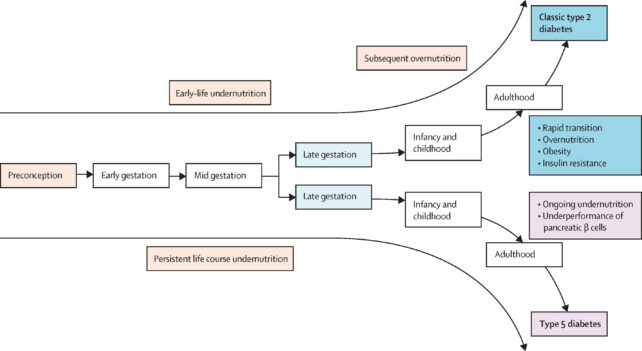
Undernutrition in infancy and early childhood can lead to diabetes. (Wadivkar et al., The Lancet Global Health, 2025)

"Inappropriate insulin treatment could induce hypoglycaemia [low blood sugar levels], which can be a particular risk in settings with food insecurity and where glucose monitoring might not be affordable," Hawkins and colleagues explained, in a review published after type 5 diabetes was formally recognized.

The issue isn't confined to Asia and Africa, either. Undernourishment is a growing problem in parts of Latin America and the Caribbean, where a complicated mix of environmental, political, and economic factors is magnifying health inequalities and extreme poverty.

"There is no quick fix, and so we expect the fight against this disease to require substantial further research and advocacy," said Hawkins in an interview.

"Once you have seen young patients dying from inappropriate treatment of a neglected form of diabetes, there's no turning back."

https://www.sciencealert.com/a-distinct-new-type-of-diabetes-is-now-officially-recognized 

Thursday, 1 January 2026

There’s Now A Type 5 Diabetes And Doctors Say It’s Been Ignored For Decades

From timesnownews.com

After decades of confusion, Type 5 diabetes finally has a name and a global push for recognition

 In 2025, the International Diabetes Federation has officially recognised Type 5 diabetes as a distinct form of the disease, ending nearly 70 years of debate. The organisation is now urging global health bodies, including the World Health Organization, to formally acknowledge it as well.

What Is Type 5 Diabetes?

Type 5 diabetes is not linked to obesity, lifestyle, pregnancy or the immune system. Instead, it is believed to be caused by long-term malnutrition, which damages the pancreas and reduces its ability to produce insulin. First observed in Jamaica in the 1950s, patients were young, thin and undernourished—but unlike Type 1 diabetes, they did not develop ketoacidosis, a dangerous complication. They also didn’t fit the profile of Type 2 diabetes, which is usually linked to insulin resistance and excess weight.
Type 5 diabetes is believed to be caused by long-term malnutrition

Type 5 diabetes is believed to be caused by long-term malnutrition

Previously known as malnutrition-related diabetes mellitus (MRDM), this condition was briefly acknowledged by the WHO in the 1980s but later dropped due to limited evidence. Now, growing research suggests it may affect up to 25 million people worldwide, particularly in low- and middle-income countries across Asia and Africa where food insecurity is common. This is why scientists think Type 5 diabetes happens when chronic undernutrition prevents your pancreas from fully developing.


Experts say misdiagnosis is a serious issue. Because Type 5 diabetes behaves differently, standard diabetes treatment, especially high doses of insulin, may be ineffective or even harmful. Patients often need very small amounts of insulin or alternative treatments to avoid dangerous blood sugar swings.


The IDF has now formed a dedicated Type 5 Diabetes Working Group to develop clear diagnostic criteria, treatment guidelines, a global patient registry and training for healthcare professionals. Researchers believe official recognition will finally unlock funding, awareness and better care for a condition that has remained largely invisible for decades.

Type 5 Diabetes Symptoms

They often overlap with other diabetes types (thirst, frequent urination, fatigue, weight loss, blurred vision, slow-healing sores) but are often accompanied by signs of malnutrition like thinness, stunted growth/delayed puberty (in youth), anaemia, and recurrent infections, stemming from early-life nutritional deficiencies rather than just insulin resistance or autoimmunity, and typically appearing before age 30.

Tuesday, 14 October 2025

What is type 5 diabetes? Newly recognized form of the disease gets name

From livescience.com

By Clarissa Brincat

First spotted decades ago but largely forgotten, a newly named form of diabetes stems from undernutrition and is thought to affect millions 

Scientists have formally recognized a new type of diabetes, dubbed type 5 diabetes, that is thought to affect 20 to 25 million people worldwide.

The condition, which is most common in Asia and Africa, was first identified more than 70 years ago but remained largely overlooked until now.

Conventionally, medical textbooks describe three main types of diabetes: In type 1, the immune system mistakenly attacks insulin-producing cells in the pancreas, leading to dangerously high blood sugar and a risk of ketoacidosis — a potentially life-threatening condition in which the body breaks down fat for energy. Type 2, the most common form, develops when the body doesn't respond properly to insulin or doesn't make enough of it. Gestational diabetes occurs temporarily during pregnancy, marked by insulin resistance that's thought to be driven by hormonal changes.

Additionally, there are other rare forms of diabetes that can result from specific genetic mutations or diseases. But now, scientists say there's another type of diabetes with a very different cause from the other kinds.

It was formally classified as "type 5 diabetes" during an international meeting of experts in India earlier this year. (They chose the label "type 5" because other researchers have already proposed "type 3" and "type 4" for other forms of diabetes.)

"Type 5 diabetes is characterized by insufficient insulin secretion leading to elevated blood glucose levels, similar to other forms of diabetes," Dr. Rachel Reinert, an endocrinologist and assistant professor at the University of Michigan, told Live Science in an email. "However, type 5 diabetes is not associated with autoimmunity (as in type 1 diabetes) nor insulin resistance (as is common in type 2 diabetes)." It also lacks the features of the more rare type 3 and type 4 diabetes, she said.

"Individuals with type 5 diabetes typically have low body weight and a history of undernutrition starting in early life," Reinert said. Doctors think that chronic undernutrition damages the pancreas early in life, leaving its insulin-producing cells permanently weakened. So the pancreas cannot make enough insulin, but if a patient is given insulin as treatment, their cells are able to respond to it.

Treatment for type 5 diabetes needs to be managed carefully as too much insulin, coupled with too little food — a common reality in low-income countries — could result in dangerously low blood sugar. "It is important for all patients with diabetes to know which specific type of diabetes they have, so they can get the right treatment," Reinert said.

A newly named form of diabetes is thought to stem from malnutrition in childhood. (Image credit: Dragos Condrea via Getty Images)

The YODA study

Earlier this year, the Young-Onset Diabetes in sub-Saharan Africa (YODA) study, published in The Lancet Diabetes & Endocrinology, renewed interest in the condition. The team initially set out to investigate type 1 diabetes among nearly 900 young adults across Cameroon, Uganda and South Africa.

But when the researchers analysed blood samples, they found that roughly two-thirds of participants lacked the autoimmune markers seen in type 1 diabetes. Further testing revealed that these individuals still produced small but measurable amounts of insulin, unlike classic type 1 cases. But their insulin levels were below the range typically seen in type 2 diabetes. These findings pointed to a distinct, non-autoimmune, insulin-deficient type of diabetes.

This was not the first time in history that the condition had been observed.

In the early 1950s, British physician Philip Hugh-Jones encountered a group of 13 patients at his diabetes clinic near Kingston, Jamaica, whose symptoms did not fit type 1 or type 2 diabetes. Hugh-Jones called their condition "type J," for Jamaica, but the label was forgotten and the condition was overlooked for decades.

What's in a name?

Correctly naming a disease not only helps guide clinicians to the best treatment options, it can also help researchers to track its prevalence and identify which factors affect patients' outcomes, Reinert said.

Although type 5 diabetes has likely existed for decades, a lack of research has kept it poorly understood. Recognition is key to ensuring the condition is no longer overlooked, said Chittaranjan Yajnik, director of the Diabetes Unit at KEM Hospital in Pune, India, and co-author of an international consensus statement on type 5 diabetes published in The Lancet Global Health.

"It needs further research and funding to study its aetiology [causes], mechanism and treatment," he told Live Science in an email. "Name is important to attract attention from stakeholders and funding opportunities. Otherwise it will get buried in the background noise of common varieties of diabetes."

Disclaimer

This article is for informational purposes only and is not meant to offer medical advice.


https://www.livescience.com/health/diabetes/what-is-type-5-diabetes-newly-recognized-form-of-the-disease-gets-name