Showing posts with label prevention. Show all posts

Friday, 21 August 2026

Diabetes prevention starts as early as conception, experts say

From kcl.ac.uk

Preventing type 2 diabetes could require action much earlier in life, according to experts calling for a new approach to protecting metabolic health 

A new perspective article in Nature Medicine, led by Andreas Birkenfeld, Medical Director of the Department of Internal Medicine IV at University Hospital Tübingen and Transcampus Professor of Diabetes at King’s College London, argues that preventing type 2 diabetes (T2D) should move beyond waiting until people develop abnormal blood glucose levels and instead focus on maintaining healthy metabolism throughout life.

Around 90–95% of people living with diabetes have type 2 diabetes, which develops through a complex combination of genetic, biological, environmental and lifestyle factors. While current prevention approaches often focus on people who have already developed prediabetes, the authors argue that this may miss opportunities to intervene earlier.

The researchers propose a life-course approach that recognises T2D as a gradual process, with metabolic changes accumulating over many years before the disease develops. They suggest that prevention should focus on identifying periods when people are more metabolically vulnerable and providing targeted support to preserve or restore metabolic health.


The paper brings together an international group of experts who identified ten priorities for improving diabetes prevention. These include redesigning screening approaches across the life course, recognising differences between individuals, developing clearer stages of disease progression and ensuring prevention strategies are accessible across different socioeconomic settings.

The authors argue that, rather than focusing only on preventing progression to diabetes, a key goal should be prediabetes remission, which means restoring and maintaining normal blood glucose levels (normoglycaemia).

The researchers also highlight that diabetes risk is not constant throughout life. Instead, there are periods when people may be more susceptible to metabolic changes. The first opportunity for prevention may begin before conception. Evidence suggests that the metabolic health of both parents, including factors such as obesity, may influence a child’s future metabolic health.

Pregnancy is another important window. During pregnancy, the body naturally becomes more resistant to insulin to support the developing baby. Some women are unable to compensate for this increased demand and develop gestational diabetes. Women who experience gestational diabetes have a substantially increased risk of developing type 2 diabetes later in life, making the period after pregnancy an important opportunity to monitor metabolic health.

The authors also highlight childhood and adolescence as important stages for protecting metabolic health. Increasing sedentary behaviours, including prolonged screen time, alongside changes in diet and activity levels, may contribute to future diabetes risk.

Later life stages, including midlife and menopause, represent further periods of increased vulnerability. For women, changes in hormone levels during menopause can contribute to changes in body composition and metabolism, which may increase diabetes risk.

We think it is no longer sufficient to wait until someone has prediabetes or diabetes before taking action. We need to recognise the stages of life when people are more metabolically vulnerable and use these as opportunities to tailor prevention and protect metabolic health.

Professor Andreas Birkenfeld, Medical Director at University Hospital Tübingen and Transcampus Professor of Diabetes at King’s College London

The article suggests that prevention should become more personalised, using information such as family history, changes in weight over time, pregnancy-related diabetes and emerging biomarkers to better understand an individual’s risk. The authors also call for future prevention research to look beyond blood glucose measurements alone and consider wider health outcomes, including cardiovascular and kidney health.

https://www.kcl.ac.uk/news/diabetes-prevention-starts-as-early-as-conception-experts-say

Monday, 10 August 2026

Got a Garden? New Research Says It Could Be Lowering Your Diabetes Risk

From startsat60.com

If you’ve ever needed a fresh excuse to get out into the garden, here’s a genuinely good one: new research from the University of Queensland has found that people with a home garden have a measurably lower risk of developing type 2 diabetes.

The UQ-led study found people with a substantial garden had a 6.8 per cent lower risk of developing type 2 diabetes compared with those who didn’t have one. Living near multiple parks made a difference too, with people 5.7 per cent less likely to develop the condition if they had several parks nearby.

What the researchers found

Lead author Dr Chinonso Odebeatu, from UQ’s School of Public Health, said the findings add fresh weight to the case for greenspace being treated as a genuine public health priority, not just a planning nicety.

“Current housing challenges means there are more high-density residential dwellings under development, and this research shows public health considerations need to be prioritised when planning greenspaces,” Dr Odebeatu said.

She said the findings showed a garden was about more than appearances. “The evidence shows having a garden is more than just aesthetics, because people’s health will be impacted if green space isn’t factored into residential developments.”

The study analysed data from more than 19,000 UK Biobank participants living with type 2 diabetes, assessing how much greenspace – including private gardens and parks within an 800-metre radius – was available at each person’s home address.

Source: Getty Images

Why gardens might make such a difference

Associate Professor Nicholas Osborne said there were several plausible explanations for the link between gardens and lower diabetes risk. Beyond the physical activity gardening naturally involves, simply spending time outdoors helps boost vitamin D levels and delivers genuine mental health benefits through what researchers call the “restorative” effects of green space.

“Being outdoors also exposes people to a range of microbes that improve gut health and boost the immune system,” Dr Osborne said.

The stakes are significant on a global scale. Dr Osborne noted more than 500 million people worldwide currently live with diabetes, a figure projected to nearly double to 1.31 billion by 2050.

“The findings from this study show how public health needs to be considered in urban planning because the decisions we make today will impact our future health,” he said.

The research, published in BMC Public Health, was conducted in collaboration with Boston’s Channing Division of Network Medicine, the Dana-Farber Cancer Institute, and Portland State University.

Why this matters for gardeners

For the many older Australians who already count gardening among their favourite pastimes, this research offers a genuine, evidence-based reason to keep at it – or to start, if you’ve been on the fence. It’s also a timely reminder for anyone downsizing into an apartment or townhouse to weigh up access to a balcony, courtyard or nearby park as more than just a lifestyle preference.

What to Do in the Garden This August

With spring just around the corner, August is a genuinely productive month in the garden – the perfect excuse to put this new research into practice. Here’s what to focus on, wherever you are in Australia.

Get planting. August is prime time for winter vegetables and herbs. Try beetroot, broad beans, carrot, kale, leek, lettuce, onions, parsnip, peas, radish, rocket, silverbeet and spinach, along with herbs like basil, chives, coriander, oregano, parsley, mint and thyme. In warmer, frost-free areas, you can also start tomato, capsicum, chilli and eggplant seeds indoors or under cover, ready for spring.

Finish your bare-root planting. This is the last real window for bare-rooted fruit trees, roses and deciduous plants before they begin shooting. If you’ve been meaning to add a new fruit tree or rose bush, get it in the ground now.

Prune and tidy. Finish pruning roses by mid-August, cut back passionfruit vines by around a third to encourage strong spring growth, and remove any spent or diseased flowers from azaleas and camellias after flowering finishes.

Feed and mulch. Top up mulch across vegetable patches, herb gardens and ornamental beds, and give tired winter soil a boost with a slow-release fertiliser or pelletised manure to wake plants up ahead of spring.

Watch for pests. Aphids often target the soft new growth on roses this time of year — a firm squirt with the hose is often all that’s needed, or encourage ladybirds into the garden as a natural, ongoing solution.

Look after your tools. On the cold, wet days that keep you indoors, take the opportunity to clean, sharpen and oil your garden tools. It’s a small job that saves both money and plant health in the long run.

https://startsat60.com/media/lifestyle/hobbies-lifestyle/gardening/got-a-garden-new-research-says-it-could-be-lowering-your-diabetes-risk 

Monday, 3 August 2026

Opinion: The fastest way to make America healthier isn’t another drug — it’s dinner

From nypost.com

By Andrew Gruel

The quickest way we can make America healthier, starting today, is to cook more food in our own kitchens. 

This isn’t for next year or after Congress passes another bill; it’s today. 

The more often people cook at home, the healthier they eat and the lower their risk of obesity, Type 2 diabetes and a portfolio of other chronic diseases. Imagine if every American family replaced just one takeout dinner each week with a home-cooked meal made from real ingredients.

Somewhere along the way, we stopped teaching Americans how to cook.

                                                                       Secretary Robert F. Kennedy, Jr. and Andrew Gruel

Schools ripped out home economics classes and kitchens, as families got busier. Real food became extinct while convenience became king. Instead of learning how to roast a chicken or scramble an egg, generations grew up learning how to peel back plastic lids, hunt for $1 menus and press the microwave button. 

What was the inevitable result? We traded cooking for convenience, and real food for products designed in laboratories — and America got sick. 

Walk through the center aisles of almost any grocery store, and you’ll find shelves lined with boxes whose ingredient labels read like a Tolstoy novel.

Meanwhile, the healthiest parts of the store, the perimeter that stores the produce, meat, seafood, dairy and eggs, are often ignored because too many Americans have never been taught what to do with them. So they default to Lean Cuisine, drive-thrus and Hot Cheetos.

I understand this because I lived it. 

I grew up in New Jersey with two hardworking parents. Dinner wasn’t a family ritual; it was whatever could get on the table the fastest. The microwave was the family chef (chef Mike) and fast food or pizza filled in the gaps. I honestly didn’t know eggs could be cooked any other way until I skipped school one day as a 12-year-old and stumbled onto PBS cooking shows. 

Watching someone transform a handful of simple ingredients into an incredible meal completely changed how I looked at food.

I was intimidated at first; then I started mixing ingredients. Within a few hours, I realized something that has shaped my entire career: Cooking isn’t nearly as hard as we’ve convinced ourselves it is.

Unfortunately, we’ve spent decades convincing people of the opposite.

Television has turned cooking into competition. It’s as if everyone is supposed to beat Bobby Flay, plate like Gordon Ramsay, or race the clock on reality shows. I hate to break it to you, but that’s all produced. Cooking is actually simple. 

That’s why I was excited when Health and Human Services Secretary Robert F. Kennedy Jr. asked me to appear in the first episode of “The Real Food Show.”

The goal isn’t to create a million Emerils. The goal is simple: to show Americans they can cook affordable, crave-worthy meals using real ingredients, and that those meals often cost less than relying on processed convenience foods.

This conversation couldn’t come at a more important time because for decades, our healthcare system has become exceptionally good at treating chronic disease — but we’ve become far less effective at preventing it. 

Rates of obesity, Type 2 diabetes, fatty liver disease and other diet-related illnesses continue to rise, especially among children. 

While no single food is a cure-all, we know that diets centered on minimally processed foods are associated with better long-term health. We don’t just need better medicine; we need “healthier” habits. These habits thrive in the kitchen.

My wife Lauren and I both work as chefs. We own restaurants and routinely work 70-hour weeks. Yet one thing remains non-negotiable for us: eating together as a family. Our kids help prep dinner (free labor) because kids who help prepare their own meals are more likely to eat them. It’s as if they have equity in the dish, so they consume it all. 

They become curious about food, and build confidence in the kitchen. Most importantly, they’re learning skills that will stay with them long after they’ve forgotten what they scored on a spelling test.

However, cooking together isn’t just about nutrition; it’s about slowing down long enough to share a meal with the people who matter most. To ask silly questions, watch the kids fight over the last taco. Food is the great unifier. 

My own health journey reinforced this lesson. As a competitive endurance athlete, I bought into the conventional wisdom that loading up on processed carbohydrates and seed oils was the key to performance, eating almost no protein. Instead, I developed severe irritable bowel syndrome that sent me through years of doctors’ appointments, medications and conflicting nutrition advice. 

Ironically, the pain got so bad, I left college to work in kitchens because it was a safe place to be; for me the chaos was calm while hiding in the “back of the house” — no worries about my stomach. 

As I learned more about food (going back to culinary school as well), I realized the answers to my health issues weren’t coming from another prescription; they were coming from my kitchen.

Food would fix me.

Learning to cook didn’t just give me a career; it gave me my health back. 

And that’s why it’s personal for me to share good food; it’s why I became a chef. America doesn’t need everyone to become a professional chef, nor do we need every family making elaborate three-course dinners. 

But we do need more Americans to believe they can walk into a grocery store, buy real ingredients, make a meal, and save money doing so. 

If “The Real Food Show” convinces families to cook one more dinner each week, we’ve accomplished something far more important than producing another cooking program. This administration has taken one small step toward making America healthier, one kitchen at a time.

Andrew Gruel is a chef, television host and member of the Huntington Beach City Council.

https://nypost.com/2026/08/01/opinion/the-fastest-way-to-make-america-healthier-is-not-a-pill-but-dinner/

Thursday, 25 June 2026

3 Weekend Habits That Are Quietly Increasing Your Diabetes Risk

From eatingwell.com

It’s important to prioritize your health on weekends, too 

KEY POINTS

  • Unhealthy weekend habits can make it harder to maintain healthy routines.
  • Poor sleep, excess alcohol and overeating can negatively affect blood sugar regulation.
  • Managing blood sugar through a healthy lifestyle may help lower diabetes risk.

Having a glass of wine over a shared meal with family or friends, staying up late to watch a sporting event or binge-watching a TV series with a bowl of chips on a rainy day are weekend activities you might engage in from time to time. These one-off scenarios can bring joy and are often harmless. But what happens if you take them to the extreme every weekend?

Weekend habits such as these can increase your risk of type 2 diabetes, a metabolic disease that affects the way your body processes and uses glucose, or sugar. It’s estimated that about 40 million people in the United States are living with diabetes, including 29 million who have been diagnosed and 11 million who are undiagnosed.

Lifestyle plays a significant role in the prevention and treatment of type 2 diabetes. Your dietary patterns, physical activity and sleep habits can all impact your risk.

“Consistency matters over perfection,” shares Kaitlin Hippley, M.Ed., RDN, LD, CDCES. “While less-structured weekend habits don’t ‘undo’ healthy habits from the week, repeated patterns can make it harder for the body to maintain stable blood sugar.”

Read on to learn more from diabetes experts about the three weekend habits that can sneakily increase diabetes risk, along with lifestyle changes that can help you reduce your risk.  

                                                         Credit:  Design elements: Getty Images. EatingWell design

1. Not Getting Enough Sleep

All three experts agree: Your weekend sleep habits matter, and consistently skimping on rest can raise your risk of developing diabetes over time. 

“Not getting enough sleep on the weekends can negatively affect your blood sugar regulation,” says Hippley. “Sleep restriction and irregular sleep patterns may increase cortisol levels, disrupt hunger and fullness hormones and increase insulin resistance.”

When your cells are resistant to the insulin your body produces, sugar remains in the bloodstream instead of being transported into cells to be used for energy. Over time, blood sugar levels rise, increasing the risk of prediabetes and type 2 diabetes.

“Even a few nights of poor sleep can decrease insulin sensitivity and increase cravings for high-calorie, high-sugar foods,” says Vandana Sheth, RDN, CDCES, FAND. Combined with poor sleep, regularly overeating high-calorie foods can contribute to weight gain, a risk factor for developing diabetes.

2. Excess Alcohol Intake

Binge drinking (defined as four drinks for women or five drinks for men in one sitting) on weekends is a harmful habit and carries multiple health risks. Compared with not drinking at all, both occasional binge drinking and frequent binge drinking have been linked to a higher risk of type 2 diabetes and high blood pressure. Alcohol can damage the liver and increase inflammation, which can negatively affect blood sugar regulation.

Additionally, drinking multiple drinks over the course of a weekend can lead to excess calorie intake, especially paired with late-night eating. “Alcohol intake can disrupt sleep, affect appetite regulation and may lead to poor food choices,” says Sheth.

While letting loose and enjoying an occasional drink isn’t likely to derail your health, try to reserve alcohol for special occasions and limit how many drinks you have in one sitting. Sheth recommends setting a weekend drink limit and drinking a glass of water between alcoholic beverages to help slow down alcohol consumption.

3. Overindulging in Foods High in Sugar & Fat

After a long workweek, dining out can feel like a welcome break from cooking and clean-up. But turning it into a routine habit may influence your risk of developing type 2 diabetes. 

“Frequently overindulging in highly processed foods and added sugars on the weekends may make blood sugar management more challenging over time,” says Hippley.

Portion sizes play a role, too. “Oversized portions high in refined carbohydrates, sodium, added sugars and saturated fat can negatively impact blood sugar and heart health over time,” says Sheth.

If you dine out often, consider choosing smaller portions of fibre-rich carbohydrates (e.g., whole grains, legumes, starchy vegetables like potatoes), lean proteins (e.g., fish, tofu, beans, chicken, turkey, lean beef) and healthy fats (e.g., avocado, nuts, olive oil) for balanced nutrition without sacrificing enjoyment.

Alternatively, try sharing meals if portions are large, or take half of your meal home for leftovers.

Tips for Lowering Risk

Your lifestyle can play a vital role in reducing your risk of diabetes. Hippley recommends small, consistent changes, as they are often more effective than extreme short-term approaches. Here are some tips for lowering your risk:

  • Stay Active. Movement is important for heart and metabolic health, so try to be active on weekends. “Some movement is better than none. At the very least, go for a 5– to 10-minute walk after meals for better blood sugar regulation,” says Sheri Gaw, RDN, CDCES.
  • Prioritize Sleep. “Aim to stay consistent with your sleep pattern throughout the week. Just small adjustments in your sleeping routine like winding down 15 to 30 minutes earlier each night can help,” says Gaw.
  • Eat Balanced Meals. Gaw also recommends prioritizing vegetables at all meals, including on weekends. “Balance greasy indulgent foods with something healthful like a salad or piece of fruit,” she says. On most days, aim to eat a balanced, minimally processed diet that includes lean protein, fibre-rich carbohydrates, colourful fruits and vegetables and healthy fats.
  • Reduce Added Sugar. It’s best to keep added sugars to a minimum on most days. Reduce your intake of sugary foods and beverages such as sweetened drinks, cookies, cakes, candy, ice cream, table sugar and syrups. Doing so can support blood sugar management and prevent excess calorie intake that may contribute to weight gain.

Our Expert Take

It’s common to indulge a bit on weekends, but overdoing it regularly can increase your risk of diabetes over time.

“I frequently see clients who are very structured and disciplined during the week and then swing to a very inconsistent weekend schedule, which can make it harder to support long-term metabolic health,” shares Sheth. 

This doesn’t mean you can’t enjoy yourself every now and then, but try to centre most weekends around healthy habits, such as prioritizing vegetables, going for walks and drinking alcohol in moderation. These simple changes can make a meaningful difference in reducing your risk of diabetes.

https://www.eatingwell.com/weekend-habits-that-are-quietly-increasing-your-diabetes-risk-11999644

Friday, 15 May 2026

Steps To Take Toward Diabetes Prevention

From health.clevelandclinic.org

Focus on exercise, healthy eating and weight management to help lower your risk 

Diabetes affects millions of people in the United States. So, it’s normal to wonder: Can you prevent it?

Endocrinologist Mary Vouyiouklis Kellis, MD, shares six ways to help you reduce your risk and breaks down which factors you can — and can’t — change.

Can you prevent diabetes?

Diabetes happens when your blood sugar stays too high over time. There are several types, but the main forms are Type 1 and Type 2.

Type 1 diabetes is an autoimmune disease and generally isn’t preventable. Type 2 diabetes happens when your body can’t use insulin properly. This is called insulin resistance. You can help limit this resistance with lifestyle changes.

“Several factors contribute to insulin resistance, some of which you can change, like your weight and eating habits,” Dr. Kellis says. “Preventing Type 2 comes down to lowering your overall risk.”

Here’s where to start.

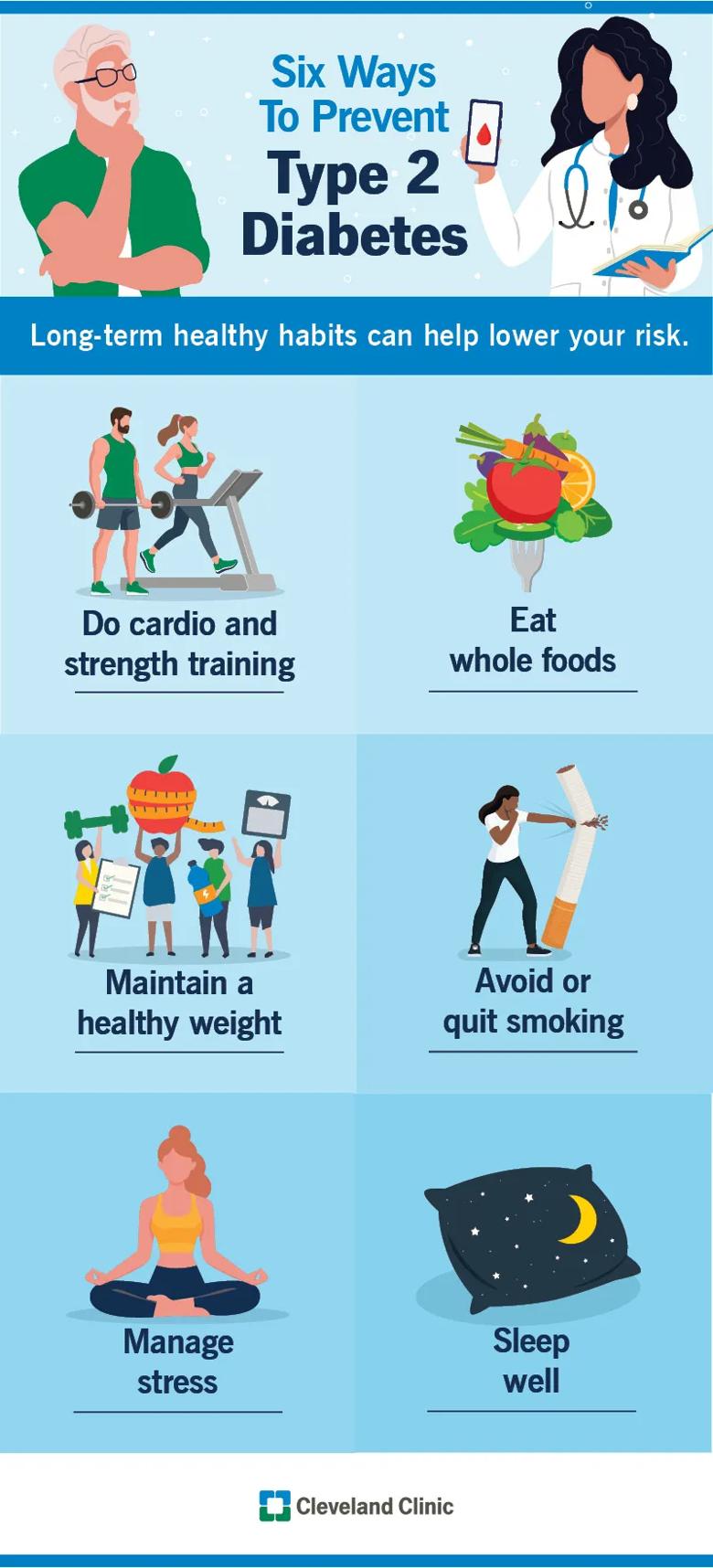
6 ways to prevent Type 2 diabetes

Six ways to prevent Type 2 diabetes

You can take steps to prevent Type 2 diabetes. Just know that it’s more of a marathon than a sprint. It involves long-term healthy habits. Dr. Kellis details the six goalposts of T2D prevention.

1. Get regular exercise

Moving your body regularly helps lower your blood sugar level in both the short and long term. It can also support a healthy weight.

“The general recommendation is 150 minutes of moderate-intensity exercise a week,” Dr. Kellis explains. “A mixture of strength training and cardio is the most beneficial.”

The key is finding forms of exercise you enjoy. And you don’t need a gym membership to do this. Activities like yard work, dancing and even lifting loads of laundry are all forms of physical activity.

2. Eat nutritious foods

What you eat can affect your blood sugar more than you might think. Some foods — especially ultra-processed ones — can cause sharp spikes. Focusing on balanced meals over time can help lower your risk.

Providers often point to eating plans like:

Nutritious, balanced meals are beneficial for everyone, whether you have diabetes or not.

“We all need to focus on a healthier lifestyle,” Dr. Kellis notes. “Aim for meals that include a mix of protein, vegetables and complex carbs.”

3. Maintain a healthy weight

Excess body fat, especially in your belly and around your organs, makes it hard for your body to use insulin.

“Obesity is one of the most significant risk factors for Type 2 diabetes that you may be able to modify,” Dr. Kellis states.

So, what’s a healthy weight for you? It’s not the same for everyone. But two measures can help point you in the right direction: Body mass index (BMI) and waist circumference.

If you have a higher BMI or waist circumference, you can still make changes.

“Any weight loss can be beneficial to blood sugar management,” Dr. Kellis encourages. “Even losing as little as 5% of your total bodyweight can help.”

4. Don’t smoke

Smoking causes inflammation in your body, which can raise insulin resistance. Compared to people who’ve never smoked, those who smoke are nearly twice as likely to develop prediabetes.

From benefits like diabetes prevention to lowering your risk of cancer, avoiding smoking is a great way to protect your overall health.

But if you smoke, there’s still hope. About 10 years after quitting, your risk of Type 2 diabetes can drop to the same level as someone who’s never smoked.

5. Sleep well

Studies show sleeping fewer than seven hours at night is linked to increased insulin resistance.

“People often underestimate the power of a good night’s rest,” Dr. Kellis says. “It has profound impacts on many aspects of your health, including your blood sugar levels.”

Aim for seven to nine hours of sleep. The quality matters, too. If you still feel tired after hitting this target, you may have a sleeping disorder. See your provider for help.

6. Manage stress

Stress floods your body with hormones that spike blood sugar (looking at you, cortisol). A lot of stress over time increases insulin resistance.

There are a bunch of ways to manage stress, ranging from deep breathing to spending time outside. Find what works for you. If stress feels overwhelming, talk to your provider about it.

When to get help

Even if you do everything “right,” you can still develop Type 2 diabetes. That’s because some risk factors (like age, genetics and race) are out of your control.

This condition tends to develop slowly, so it’s helpful to see a provider for regular check-ups. They’ll offer screening tests to track changes in your blood sugar levels over time.

If Type 2 is unavoidable in your case, try to be kind to yourself. And know that you can still be proactive.

“The sooner you get a Type 2 diabetes diagnosis and begin management, the more likely you’ll avoid long-term complications,” says Dr. Kellis.

https://health.clevelandclinic.org/how-to-prevent-diabetes